
 AI Workforce


Medical Spa Software Features
Zenoti's medical spa platform brings every operational and clinical tool into one purpose-built system — AI Scribe, HIPAA-compliant charting and photo management, online booking, AI Receptionist, automated marketing, memberships, and multi-location management, all connected through a single guest record. Your clinical team and front desk work from the same profile, at every location, in real time.
Explore the complete feature set below — each section links to the dedicated product page or case study for more detail.

Clinical documentation and EMR
When a guest sits down in your treatment room, they expect precision, privacy, and a provider who knows their full history. Zenoti's clinical layer delivers all three — procedure-specific charting, HIPAA-compliant photo documentation, digital forms, and e-prescriptions, all inside the same platform your front desk and marketing teams use. One complete guest record from the first consultation through every follow-up visit.
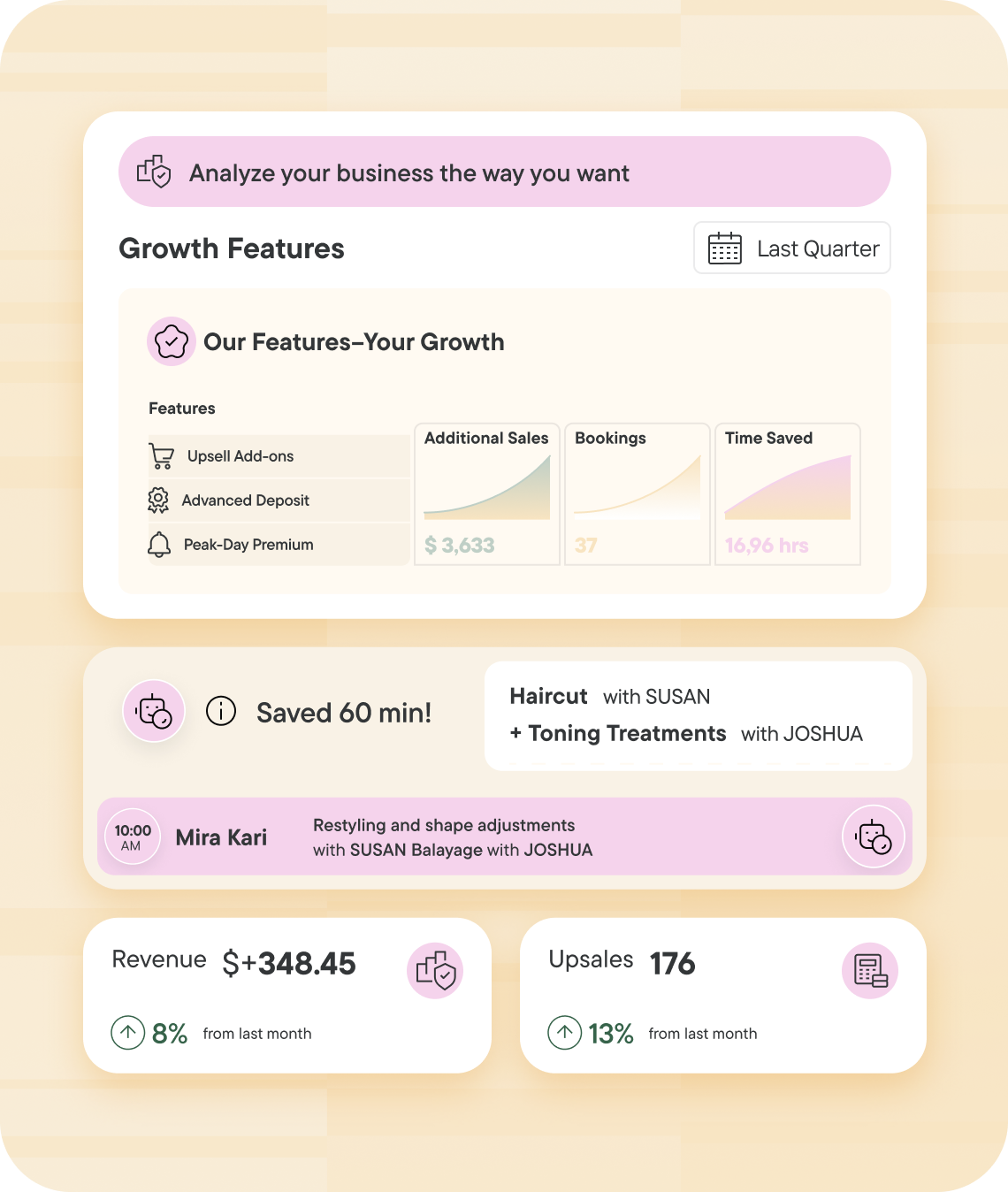
AI Scribe listens to the provider-guest conversation and instantly generates structured, editable chart notes — so providers stay focused on the guest, not the keyboard. After each session it produces a clean summary with verified findings, pre-filled chart notes in the correct format, and drafted post-care instructions, ready for review and sign-off in seconds. The transcript and recording are always available for reference, giving providers full transparency before approving any AI-generated data.
The value compounds across a full day of appointments. For a Botox session, approximately 8 minutes of documentation time is recovered per appointment. Across three providers seeing clients five days a week, the time saved translates to an estimated $429,000 in annual value for a practice — through a combination of additional treatment capacity, freed provider attention for higher-value consults, and improved plan acceptance rates.
When providers stop taking notes, they start listening. See what happened at Spa 35 Medical Spa when every provider moved to AI Scribe.
Charting templates are structured to the procedure — not a generic text field. An injectable note captures product, units per site, lot number, expiration date, and provider as structured fields; laser notes capture device model, settings, and pass counts. Providers copy from a previous session and adjust — charting a follow-up takes seconds.
Photos are captured within Zenoti, linked to the specific visit and chart note, and stored in a HIPAA-compliant environment. A guided library of 200+ face and body maps ensures consistent angles, photo ghosting aligns post-treatment shots with pre-treatment ones, and a centralized gallery with smart tags surfaces images for consultations and marketing. Every access event is logged for audit.
Sent via SMS or email before the appointment and completed on the guest’s own device, the forms feed directly into the patient record — no paper, no manual entry. The allergy eligibility test is built into the appointment book, and form templates can be configured per location for multi-location brands.
Licensed prescribers send prescriptions electronically from the guest's Zenoti record to any Surescripts-connected pharmacy. The prescription is logged in the clinical history and available for medical director review — most relevant for medspas offering medical weight loss, hormone therapy, or topical prescription skincare.
Every injectable treatment logs product, dosage per zone, lot number, and expiration date - updating inventory in real time as the chart is completed. Near-expiry batches surface automatically with suggested substitutes, and full traceability supports regulatory audits and recall management.
Medical directors access patient records, chart notes, and treatment histories across all locations from a single login. A review dashboard lets directors assign, check, and approve treatments. In addition, minimum form-submission requirements flag incomplete documentation before review begins.
Pre-consultation digital intake, an in-consultation view of the full profile (contraindications, alerts, history, medications, allergies, vitals) with a personalized plan and custom quote, and post-consultation automated pre-care instructions. When the guest accepts the quote, the booking is created from it with all details and pricing carried over.
saved per Botox appointment
recovered by AI Scribe
annual value — 3-provider practice
Warren Danforth model
lift in plan acceptance
from richer consults
“With AI Scribe, we can reduce appointment lengths on our most popular service by nearly 50% - confidently moving a 30-minute slot to 15 minutes and opening more capacity. It’s an invaluable tool for provider productivity and patient experience.”
Warren Danforth
Owner, Spa 35
Booking and scheduling
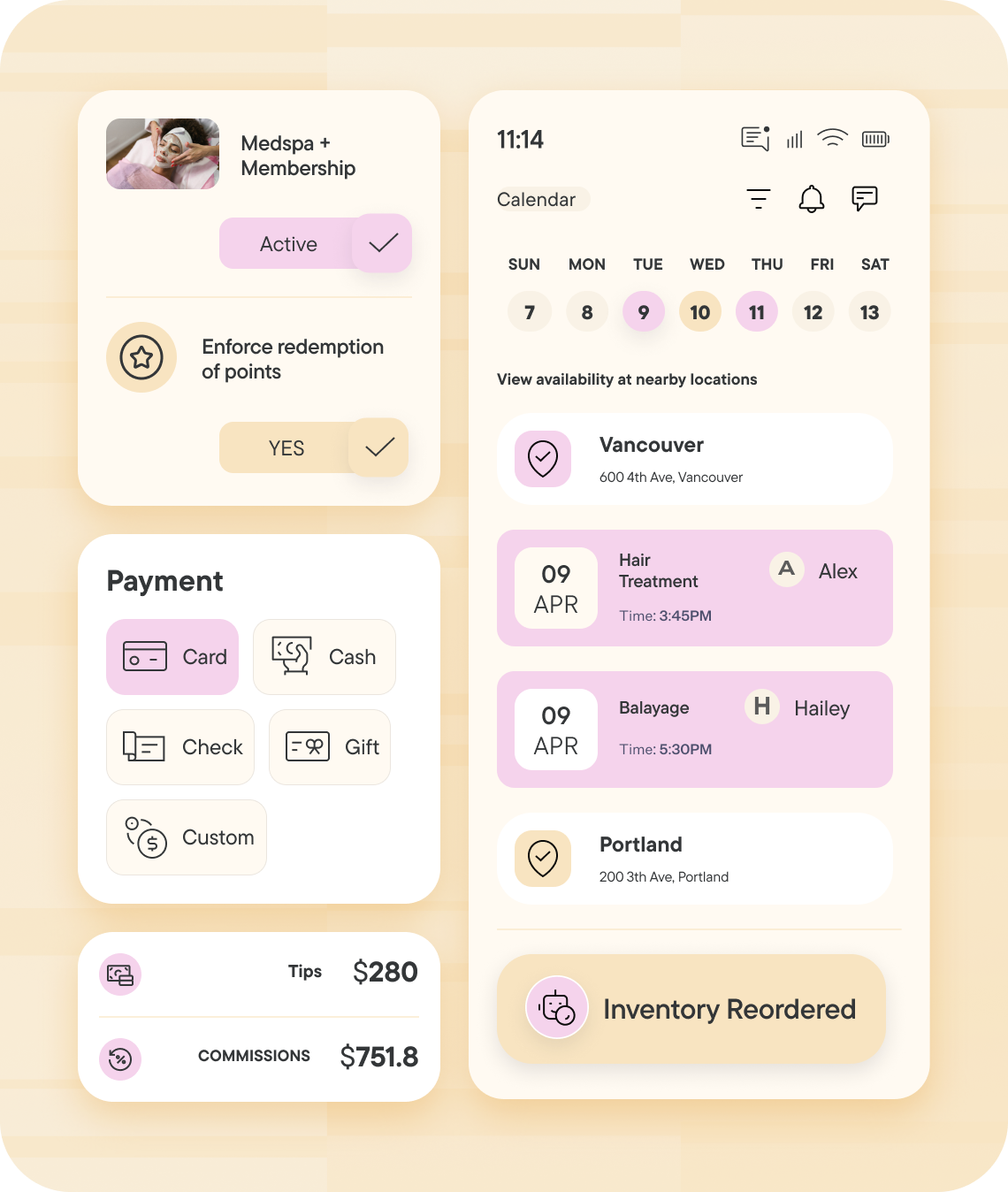
Your appointment book is the operational heartbeat of your medspa. Zenoti's scheduling layer handles every booking scenario - the guest who plans online at midnight, the returning guest who wants their specific provider, the walk-in who needs the waitlist - with clinical intelligence that generic booking tools just cannot match.
Guests select their preferred provider first, with bios, certifications, photos, and specialties visible during selection. Deep links - shareable on social or by the provider - take guests straight to a specific provider's availability, driving higher conversions from loyal patients.
Guests book from your website, branded mobile app, social channels, and directly from Google. Membership credits, package balances, and offers display automatically; the waitlist captures interest when a time is unavailable; and abandoned-cart recovery recovers guests who drop off mid-booking.
Smart color coding, service details, provider names, room assignments, and real-time status let front desk staff spot updates and access profiles at a glance. Allergy test results appear directly on the appointment book - no extra screens, no missed flags.
Define provider availability by service, time, and day; restrict which providers appear for specific services online. Add-on time scaling reflects clinical effort and room availability, and service prerequisites and finishing services are offered automatically during booking.
When a preferred time is unavailable, the waitlist captures details and notifies the guest the moment a slot opens. Services with clinical prerequisites, such as a prior consultation or patch test, automatically enforce that sequence during booking.
Guest communications and AI Receptionist
Per the Zenoti 2024 Medspa Consumer Survey, 35% of medical spa regulars named limited office hours for booking as a source of frustration. Occurring throughout the day, however – not just when a medspa is closed – every missed call compounds into missed memberships and lost revenue. Zenoti closes that gap with an always-on communication layer covering every touchpoint from the first call to the post-visit follow-up.
AI Receptionist answers incoming calls 24/7 - booking, rescheduling, answering service questions, and handling routine queries with natural responses that reflect your medspa's tone. No call goes to voicemail, and the front desk runs without additional headcount, even outside business hours.
When a call goes unanswered, SmartBot follows up immediately with a personalized SMS - helping the guest book, reschedule, or ask questions without waiting on hold. The automatic exchange happens in your brand voice.
A single platform for all guest communication - SMS, WhatsApp, and in-app messaging - with full conversation history per guest. Saved Response templates let staff reply in seconds, and automated responses engage guests outside business hours. Every message is visible to any authorized team member.
After a booking, guests automatically receive confirmations, pre-care instructions, and form links via SMS and email. AI-powered reminder calls in a natural voice nudge guests to confirm and complete forms, and post-visit instructions, rebook prompts, and review requests send automatically.
reduction in no-shows
VIO Med Spa — 28 locations
hours saved monthly
with Saved Response templates
guest engagement
automated outside business hours
“Zenoti is the engine behind our growth. The branded app makes scheduling effortless for our clients, and our team loves how easy it is to manage appointments and waitlists. And as we grow, Zenoti is ready to grow with us.”
Kate Engelbrecht
Co-Founder, Woven Medspa
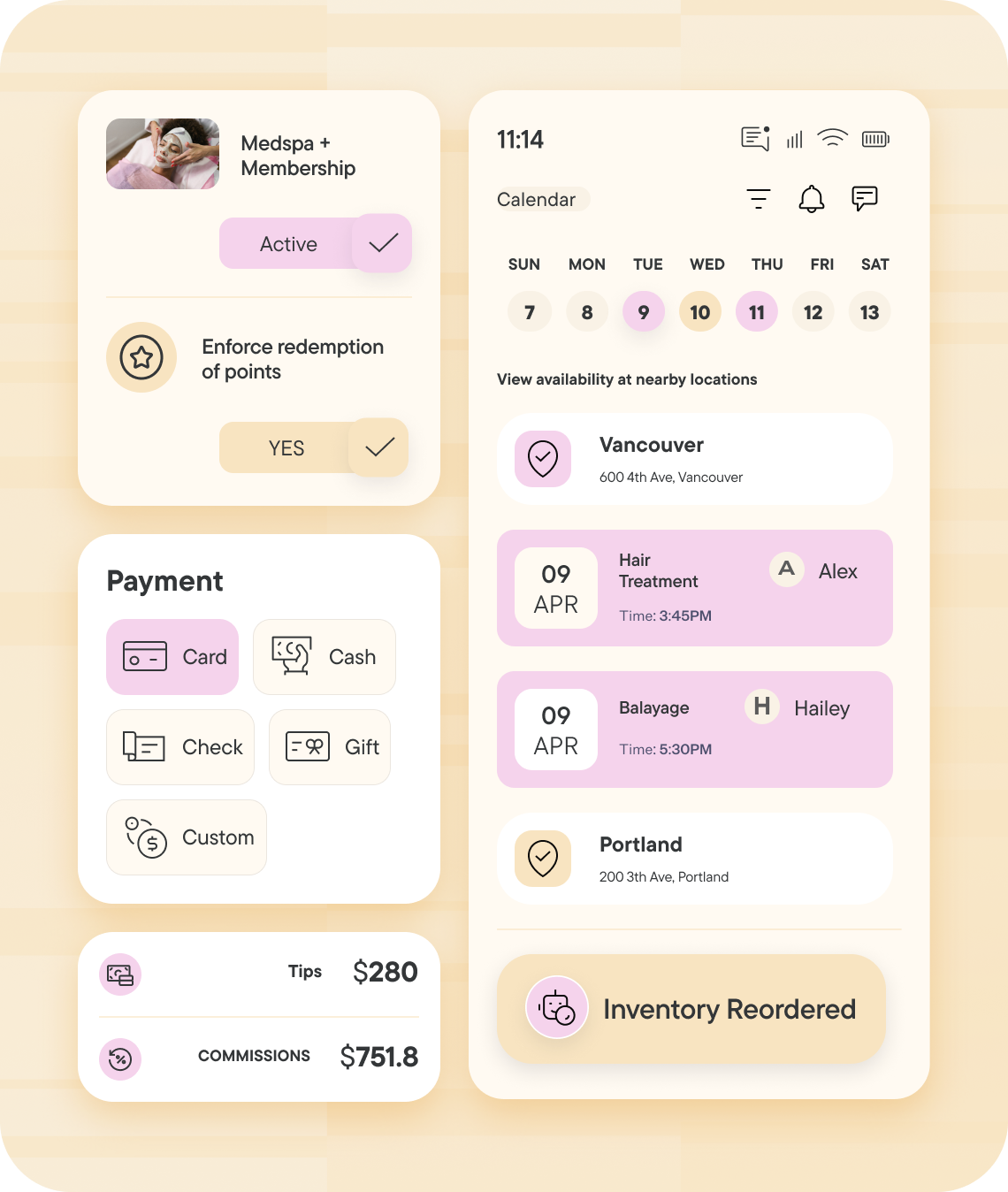
Marketing and guest retention
Growing a medspa means converting the guests who are already interested — prospects who filled out a form but never booked, those who haven't visited in three months, loyal regulars who don't know about your new treatment. Zenoti's marketing engine automates all of it, running continuously while your team focuses on great experiences.
AI-powered campaigns re-engage lost guests, convert prospects, and drive upsells — without manual setup. The platform analyzes guest history and proposes always-on flows: re-engaging prospects, recovering inactive guests, and driving cross-sell revenue. Every campaign runs automatically, every day and at every location.
Build segments by treatment history, membership status, package balance, visit recency, and spending. Target guests who never bought a package, re-engage those who haven’t returned in 90 days, or reach Botox guests who’ve never tried filler. AI builds the segment and content; your team approves before teh content sends.
Automated add-on suggestions go to guests before their appointment, lifting average ticket without front desk involvement. At checkout, smart package recommendations surface relevant series based on the services just performed.
Monitor and respond to Google and Facebook reviews from one dashboard, with sentiment trends over time. AI-generated response suggestions let your team reply to every review in seconds, reflected in the guest timeline.
Inquiries from forms, website visits, and inbound calls are captured in one place and routed to the right team member. AI-driven engagement follows up automatically based on behavior, prioritizing high-value leads, with drip flows and AI voice calls keeping prospects warm.
No-show recovery campaigns trigger immediately after a missed appointment with a one-click rebook link. A built-in referral programme tracks referrals, distributes rewards automatically, and reports exactly how much revenue each programme generates.
lost customers recovered
OrangeTwist — 14 locations
lost revenue recovered
in 6 months post-implementation
prospects converted
$91,442 prospect revenue

“With Zenoti, we’ve brought back hundreds of guests for recurring visits, and now run targeted campaigns that fill slow days and drive upsells, all without pulling our team away from in-clinic care.”
Dr. Hannah Vu
Managing Director, SkinZone Laser & Cosmetic Surgery
Memberships, packages and loyalty
Generating predictable revenue for medspas, memberships contribute to their financial health. Per Zenoti's 2025 Benchmark Report – Medspa Edition, $29 of every $100 spent at medspas go to packages. Memberships correlate with a higher lifetime value in beauty and wellness. Zenoti's membership, package, and loyalty tools are built to create, sell, and retain at scale.
Create unlimited membership structures - monthly, quarterly, annual, credit-based, unlimited-visit, or tiered VIP. Members access credits and benefits from your branded app, memberships travel across the network (join at one location, redeem at another), and billing, dunning, freeze, and cancellation run automatically.
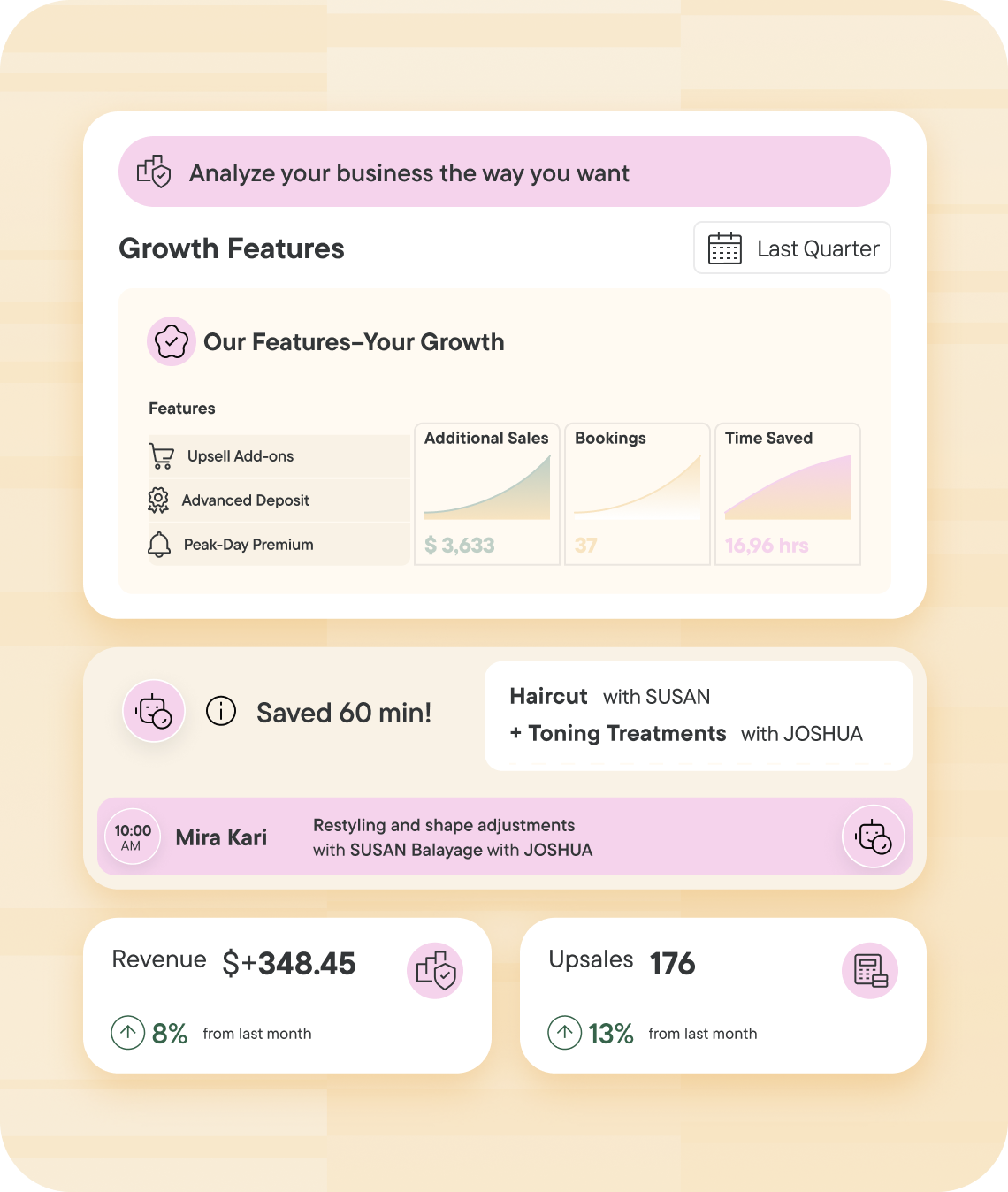
Treatment packages and series sell at booking, checkout, or the online store. Balances are visible at every touchpoint - appointment book, front desk, and the guest's app - and packages travel across locations, just like memberships.
Digital and physical gift cards sell through your website, POS, and mobile app. Balances are accessible at every location and never expire based on your configuration, with centralized liability tracking for accurate real-time data across the network.
A configurable loyalty programme rewards every visit, retail purchase, and referral. Tiered structures create aspirational milestones, points redeem seamlessly at any location, and the balance is visible in the guest's app at all times.
“Zenoti is key to our operations and guest experience. Its intuitive design streamlines our workflow and ensures a smooth, enjoyable visit every time.”
Amanda Hopper
Director of Financial Operations and Guest Services, St. George Med Spa
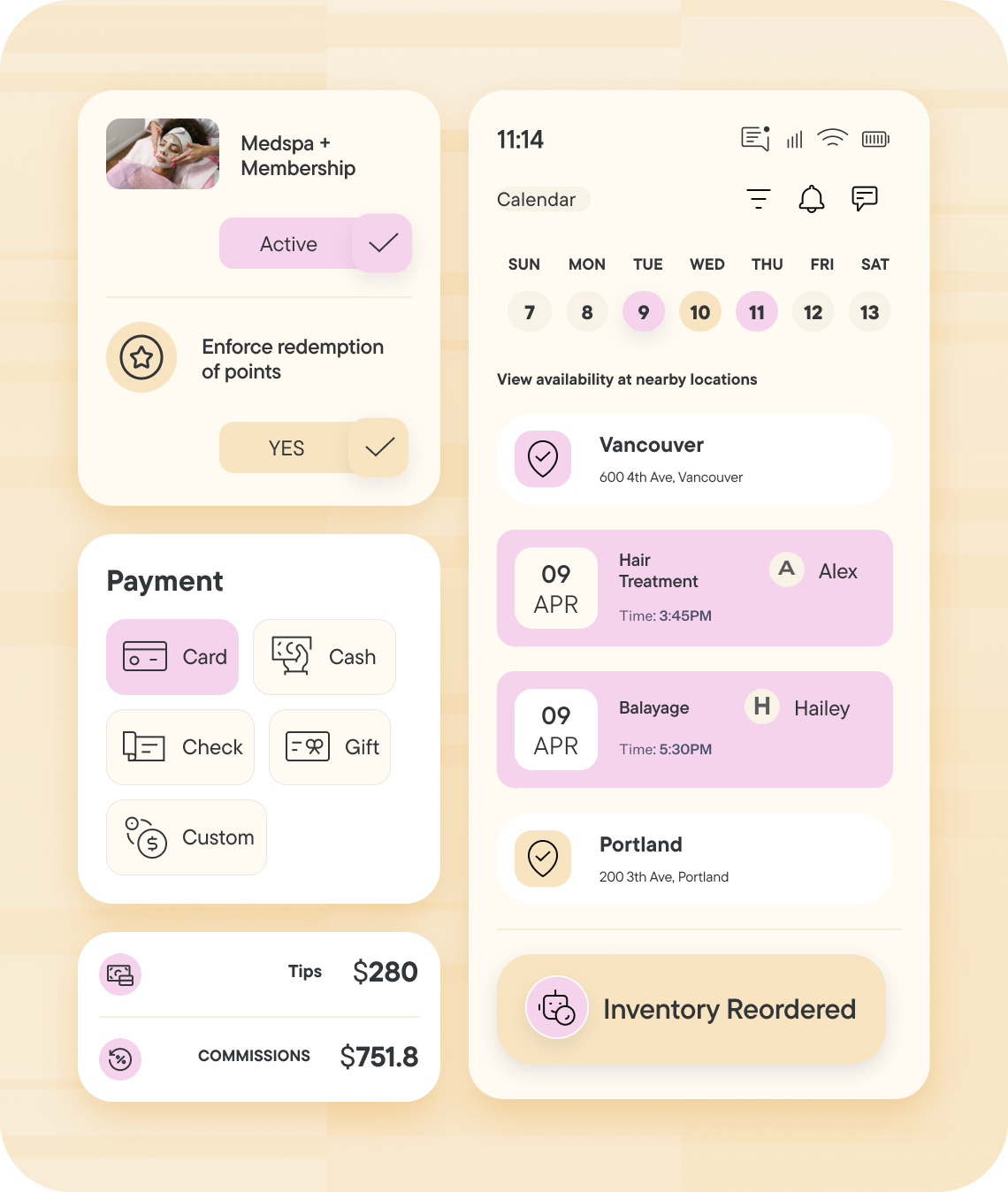
Front desk and daily operations
It’s where every guest experience begins and ends. Zenoti gives front desk teams everything in one screen - guest profile, active memberships, pending forms, upcoming appointments, and conversation history - eliminating the context switching that slows down high-volume medspa days.
Every guest's record is just a click away - visit history, memberships, package balances, appointments, notes, contra-indications, loyalty points, and feedback. The tablet-friendly profile is built for fast interactions, and staff can ask Zeenie, the built-in AI assistant, any question about a guest for an instant answer.
Guests check themselves in, complete mandatory forms, update details, and select last-minute preferences from a self-service kiosk - freeing staff to focus on the experience. Fast, contactless, and available on any tablet you already own.
Opening, closing, and adjusting your register is handled from one interface, with denomination-level precision, petty cash rules, and full audit trails across multi-shift centres. The system supports all payment methods - card, tap-to-pay, gift cards, packages, membership credits, and split payments - in a single transaction.
The invoice is ready automatically - service and add-on charges, consumables, membership discounts, package benefits, commissions, and taxes. Client mode lets guests review and pay from the treatment room, with upsell recommendations surfaced based on history and the treatment just performed.
Staff management and payroll
Your providers are not just your product – they are the beating heart of your business. Retaining clinical talent, tracking performance accurately, and paying on time without errors directly affect guest experience. Zenoti manages all of it - from provider profiles and performance dashboards to fully integrated payroll.
Each service provider has a profile linked to social accounts, a before/after gallery, and patient preference data - visible during booking. ezPulse gives real-time visibility into revenue, rebooking rate, guest ratings, and utilization, with a leaderboard that motivates improvement.
myZen brings scheduling, shift confirmation, and built-in chat into one mobile interface. Providers get notified instantly when a guest checks in, with the guest's full clinical profile delivered before they enter the room. Helping managers with staff retention, pulse surveys flag early signs of burnout.
Self-paced online courses cover business operations, platform features, and clinical best practices. Staff complete and certify from their own device, and managers track completion so every team member meets the same standard regardless of location.
Zenoti Integrated Payroll pulls from daily operations — services, commissions, tips, retail — to calculate payroll automatically. Handles W-2 and 1099 staff, all 50 states, next-day deposits, with pay stubs and tax forms in the myZen app.
Providers receive earned tips without waiting for the standard payroll cycle. Early tip payouts are available for US customers — removing one of the most common sources of provider dissatisfaction in the industry.
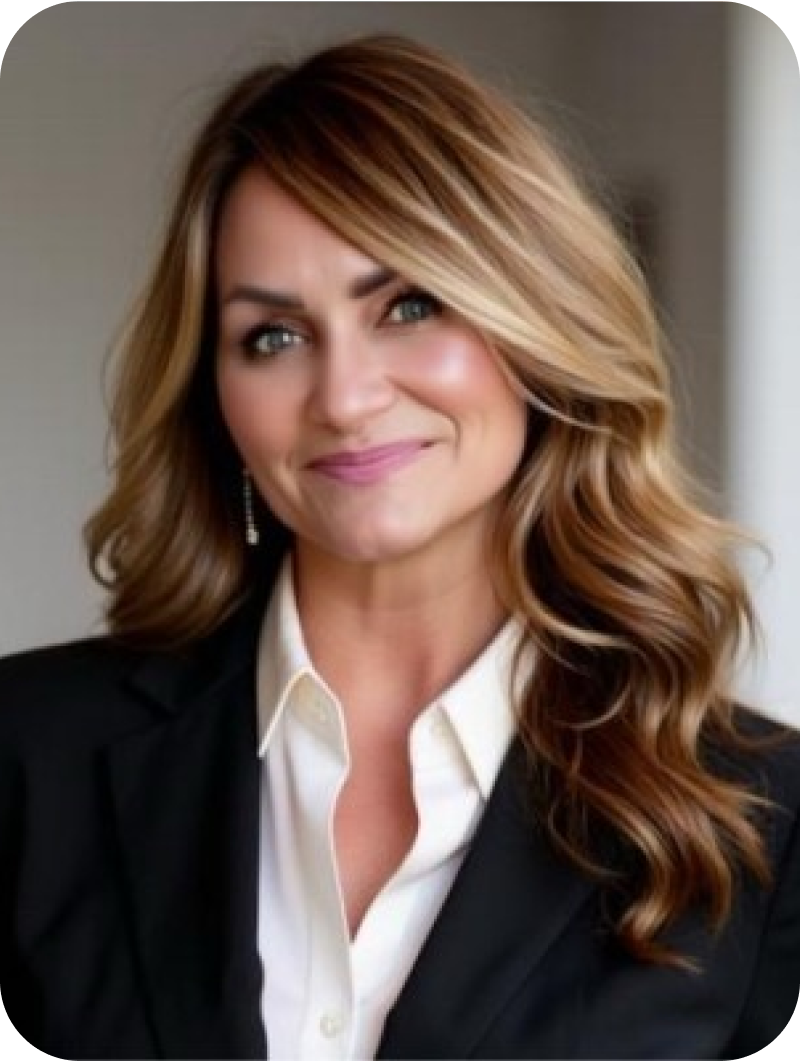
“Zenoti has had a huge impact on our business and brand. It helps us manage everything, from employee performance to customer relationships. Employees can easily track their numbers and goals with a click.”
Lora Kassaros
Practice Development Manager, Dermatique Laser and Skin
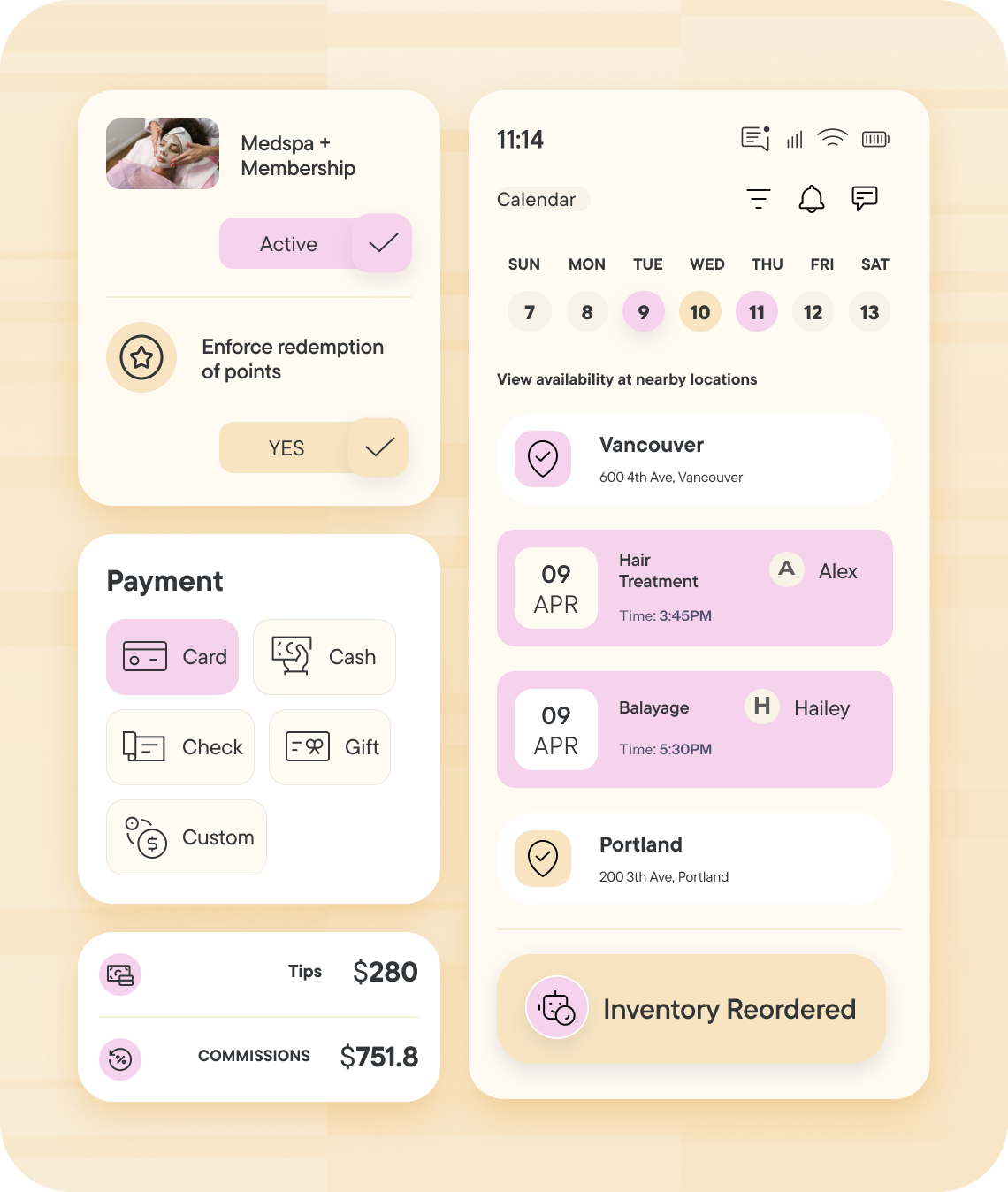
Payments and point of sale
Every treatment deserves a checkout that matches the quality of the experience. Zenoti's integrated payment layer handles every scenario - split payments, membership redemptions, package applications, tap-to-pay, surcharges - without friction or manual calculations that introduce errors.
All service charges, add-ons, consumables, membership discounts, package benefits, commissions, and taxes calculate automatically. Staff never manually apply benefits or reconcile consumables - the invoice is ready before the guest reaches the desk, and marketing campaigns apply with one click.
Guests pay using their phone or card without hardware - tap to pay from the treatment room or front desk. Every transaction is tracked end-to-end, and AI-powered dispute tools help resolve chargebacks faster.
Pass credit card processing fees to guests through compliant surcharges at checkout - across POS, webstore, mobile app, and kiosk. Detailed reports give full visibility into surcharge revenue, with state-level and card-network compliance built in.
When multiple staff are involved in a service, Zenoti automatically splits commissions equally, updating in real time as members are added or removed. Overrides remain available where a different split is appropriate.
For group bookings, a popup automatically detects available package balances for every guest in the group - enabling fast, accurate redemptions without manual tracking.
Reporting, analytics, and AI insights
Data is only valuable when it drives decisions. Zenoti's reporting layer gives real-time operational visibility, AI-powered business intelligence, and customizable dashboards - so you spend less time pulling reports and more time acting on what they reveal.
An ever-ready assistant, Zeenie is built into the interface and answers questions about your business in real time. Ask about your best-performing treatment this quarter, which providers have the highest rebooking rate, or how your no-show rate compares to last month - answered immediately, with context.
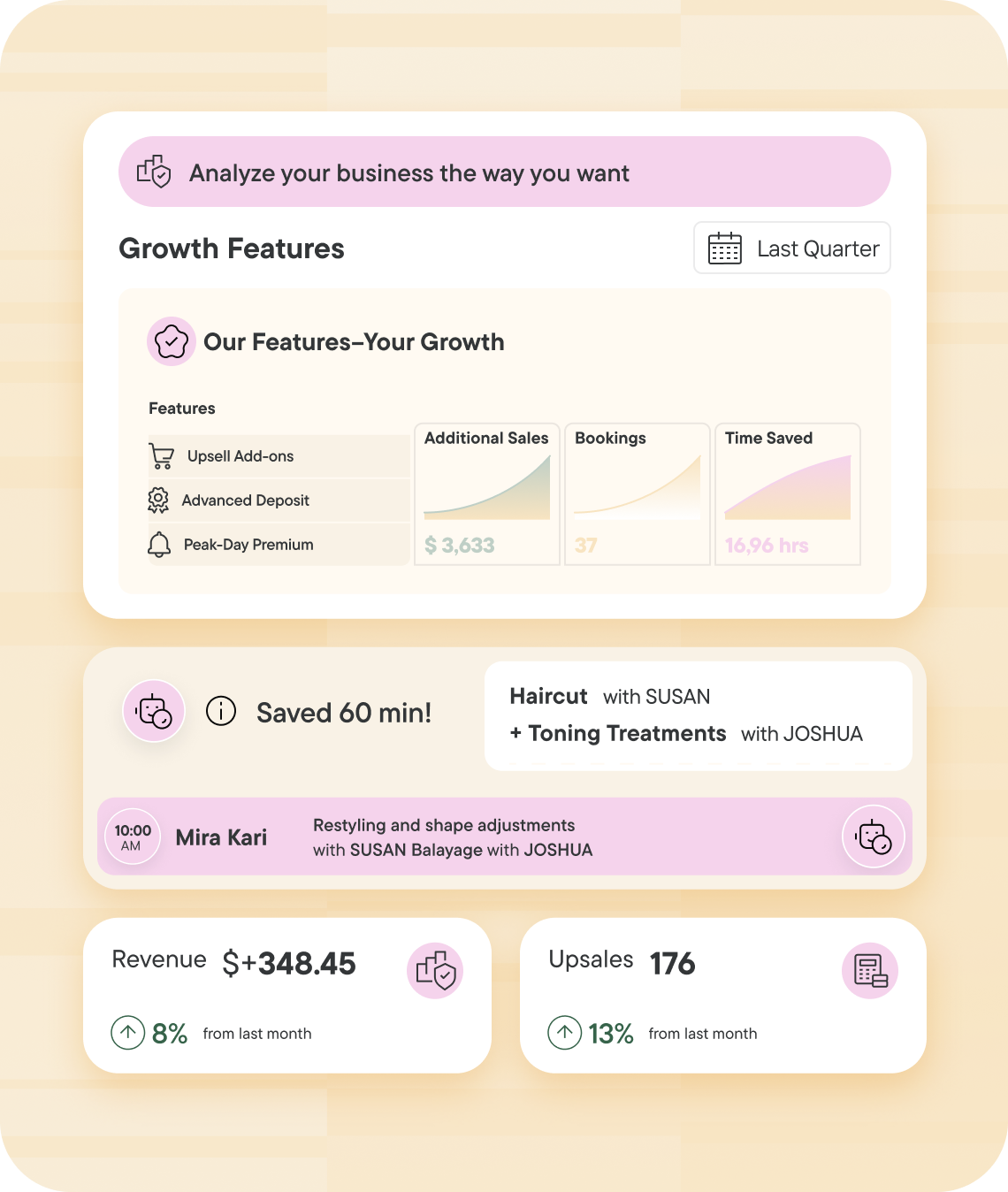
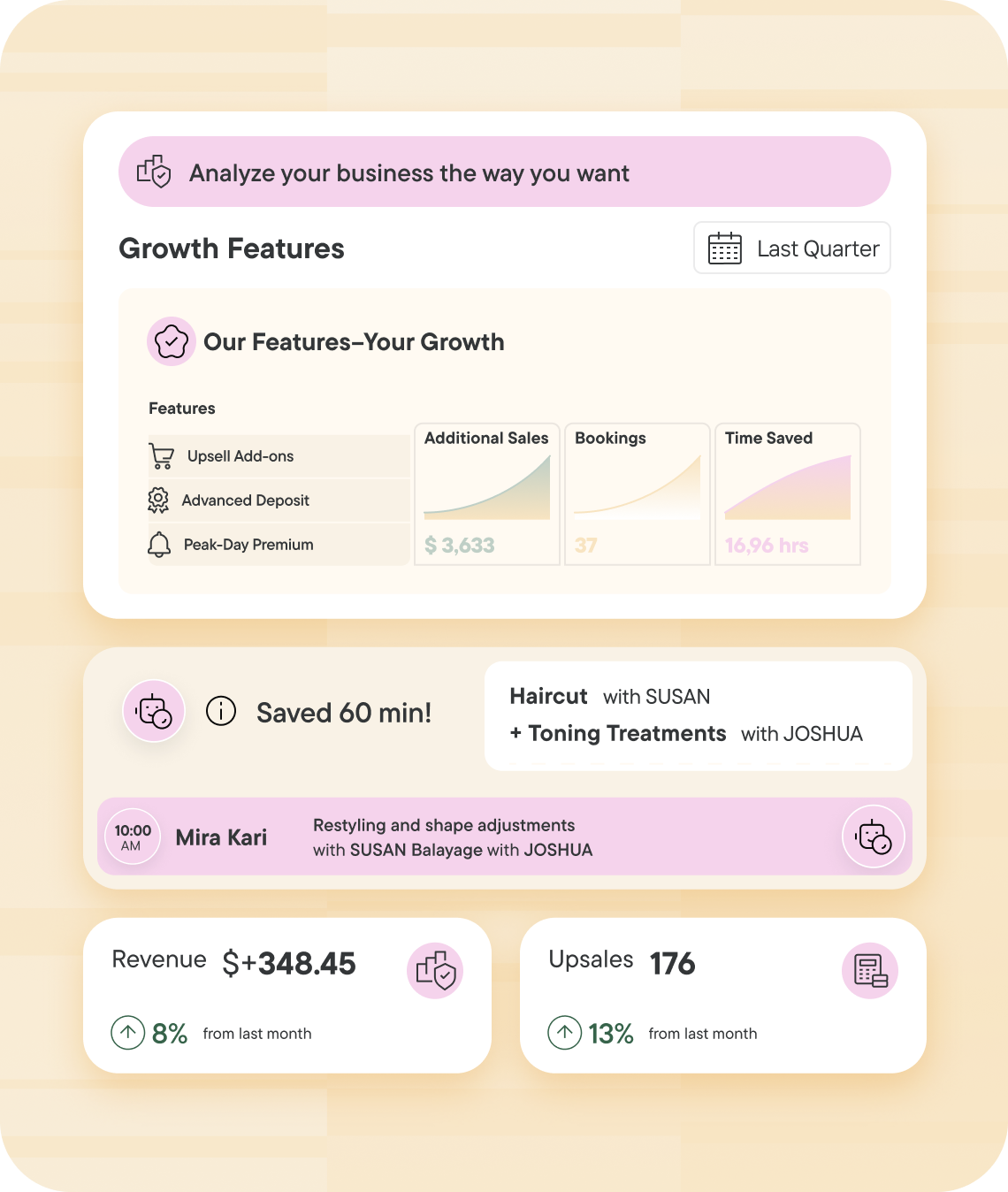
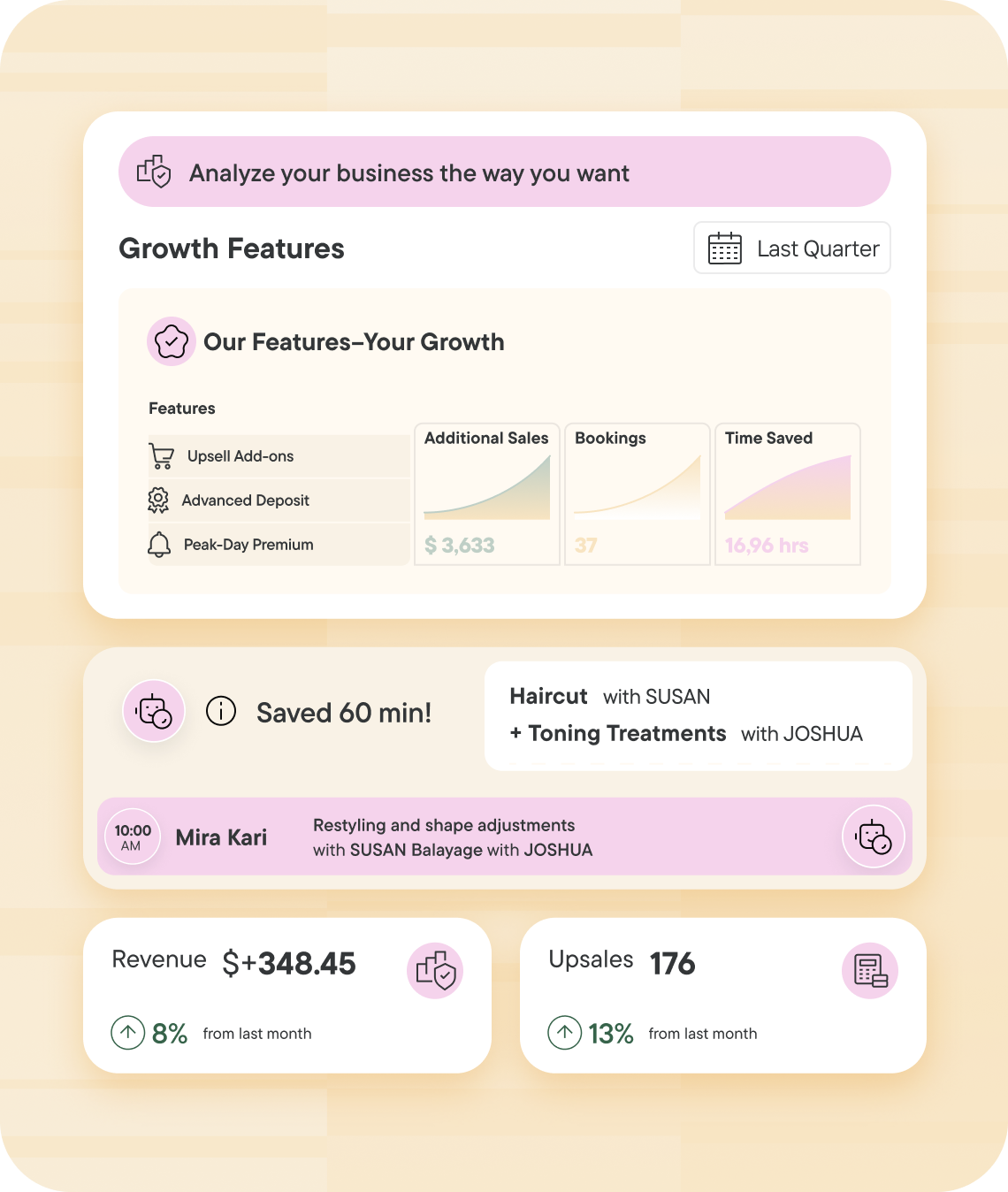
Measures the financial impact of every Zenoti growth feature in real time - revenue from referrals, time recovered by intelligent scheduling, membership conversion for the current quarter versus previous, and so on . Every growth feature has a measurable outcome attributed to the tool that drove it.
Track business health over quarters and years with shareable reports - bookings, revenue, membership growth, staff performance, no-show rates, and average ticket. Built for internal reviews, franchise reporting, and executive dashboards.
For organisations needing custom reporting beyond standard dashboards, Analytics Plus delivers tailored data solutions - appointment details, payroll insights, cross-location comparisons, any KPI - with the Zenoti team building and maintaining the dashboards for you.
Define the timeframe during which campaigns are credited with driving revenue. Compare campaign ROI across SMS, email, and referral channels with a clear, auditable window.
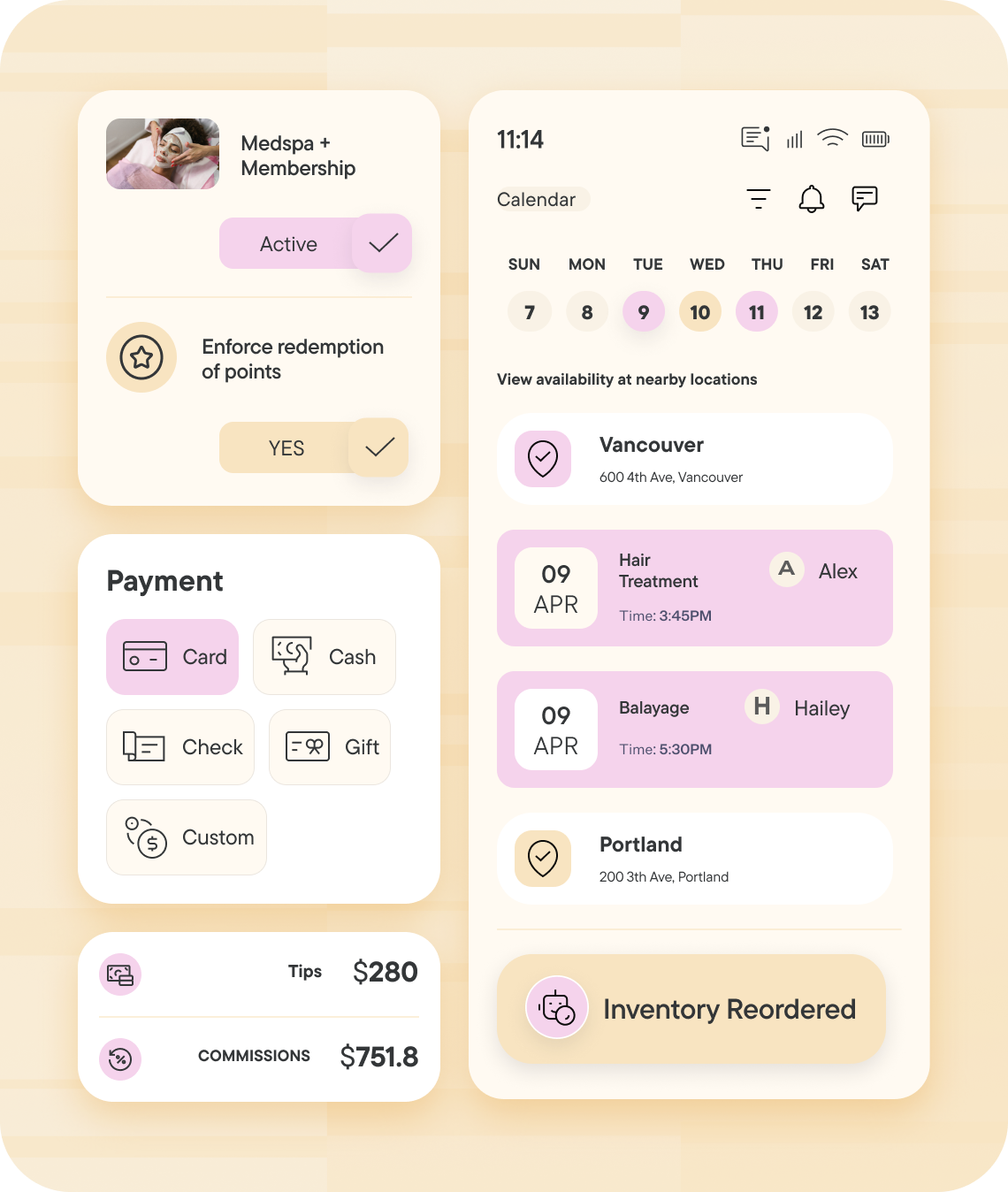
Multi-location management
Every Zenoti feature is built with more than one location in mind - because medspas that grow from one location to 100 need their software to grow with them. Centralized data, standardized operations, and cross-location guest experiences are defaults in Zenoti, not premium add-ons.
Every guest has a single, unique profile accessible across your entire network. Service history, clinical records, preferences, forms, membership balances, and loyalty points are visible at any location the moment a guest walks in. No duplicate records, no “I'm not in the system here” moments.
Services, pricing, promotions, forms, and clinical protocols are managed centrally and reflected immediately across every location. A brand-level change propagates everywhere - consistent clinical standards, guest experiences, and brand identity whether you have two locations or 200.
Executives, franchise owners, and brand managers compare performance across locations from a single dashboard - sales, utilization, staff performance, no-show rates, membership penetration, and marketing effectiveness at both brand and location level, with historical trends.
Membership credits, gift card balances, and package sessions are honored at every location, updating in real time. A guest who purchases at location A and visits location B receives the same benefits with no staff intervention - what separates enterprise-grade medspa software from single-location tools.
legacy data consolidation
Hand & Stone migration
duplicate record reduction
7M+ guest records cleaned
downtime during migration
zero business disruption
“More customers are booking online, which means less time on the phone and more time for our team to focus on guests in the spa.”
John Teza
CEO, Hand & Stone Massage and Facial Spa
Frequently asked questions
Yes — purpose-built medical spa software includes EMR functionality for medspa-specific clinical workflows: procedure-specific charting for injectables, laser, and energy-based treatments; HIPAA-compliant before/after photo management linked to the clinical record; digital intake and consent forms; e-prescriptions; and medical director oversight access. General-purpose clinic EMRs typically include functionality medspas will never use — insurance billing, ICD-10 coding, multi-payer claims — while missing the operational layer medspas depend on. Zenoti’s EMR features are purpose-built for the medspa workflow and sit inside the same platform that runs your booking, marketing, and payments.
Aesthetic consultation software manages the full consultation workflow — from pre-visit intake through clinical assessment, treatment plan creation, custom quoting, booking, and post-consultation follow-up. In Zenoti, the guest completes digital forms before arriving, the provider reviews their full clinical history during the consultation, a personalized treatment plan and custom quote are created and sent, and once accepted, the booking is created directly from the quote with pricing carried through automatically.
Zenoti is itself an EMR — for the large majority of medspas, you do not need a separate EMR alongside it. It covers procedure-specific charting, HIPAA-compliant photo management, digital consent and intake forms, e-prescription integration via Surescripts, injectable and batch tracking, and medical director oversight. For practices with unusually complex clinical documentation requirements, Zenoti provides API integrations to connect a specialized standalone EMR.
Zenoti’s charting templates are structured to the specific procedure rather than a generic text field. An injectable note captures product, dosage per site, lot number, expiry, and provider as structured fields; laser notes capture device settings and pass counts; weight loss, IV therapy, and skin notes each have their own structure. Providers copy from a previous session and adjust, and AI Scribe can generate structured notes automatically from a recorded session, ready for review and sign-off.
Yes. Zenoti includes built-in EMR functionality that is purpose-built for medical spas — clinical charting, HIPAA-compliant before/after photo management, digital intake and consent forms, complete treatment history, e-prescription integration via Surescripts, and AI Scribe for automated documentation. It is an integrated clinical layer within Zenoti’s complete medspa operating platform, so patient records sit alongside booking history, membership status, and marketing data in one system.
Yes. Zenoti provides a signed Business Associate Agreement, encrypts all PHI at rest and in transit, and enforces role-based access controls so only authorized staff can view patient records. Every access to a patient record, every chart note created or modified, and every photo viewed or downloaded is logged with a timestamp and user identity. Before/after photos are stored in a HIPAA-compliant environment and linked to the patient’s clinical record.
For most medspas, yes — and replacing a standalone EMR with Zenoti’s integrated clinical layer is often a simplification rather than a compromise. General-purpose EMRs built for primary or urgent care charge for functionality medspas never use while missing the operational features that drive revenue. For the large majority of medspa service menus — injectables, laser, skin, IV therapy, medical weight loss — Zenoti’s charting is sufficient as a standalone clinical system, and the onboarding team supports data migration from most major medspa platforms.
Procedure-specific treatment note templates for injectables, laser, skin, IV therapy, and medical weight loss; HIPAA-compliant before/after photo management with 200+ body guides and side-by-side overlays; photo ghosting; digital intake and consent forms sent pre-appointment; AI Scribe for automated note generation; complete treatment history per patient across all locations; injectable and product tracking at the lot and batch level; medical director oversight with review and approval workflows; and role-based permissions controlling who can view or modify clinical records.
Yes. Zenoti integrates with Surescripts, the national e-prescribing network connecting prescribers to more than 95% of pharmacies in the United States. Licensed prescribers send prescriptions electronically from the patient’s Zenoti record to the patient’s chosen pharmacy. The prescription is logged in the clinical history and visible for medical director review - valuable for medspas offering medical weight loss, hormone therapy, or topical prescription skincare.
Yes. Zenoti connects your medspa to social by letting you add an online booking link to your Instagram, Facebook, and Google profiles so followers book directly, automatically requesting reviews after each visit to build your reputation, and running marketing campaigns from real guest data. Bookings, reviews, and campaigns all tie back to the same patient record.