
 AI Workforce


Commission Management Software for Salons, Spas, and Medspas
Configure any commission structure — flat, percentage, or tiered — and Zenoti calculates every payout automatically across services, products, memberships, packages, and gift cards. Earnings flow straight into payroll, so providers get paid accurately, transparently, and on time.

What is commission management software for salons?
Salon commission management software automatically calculates what each stylist, therapist, or provider earns from services, retail products, memberships, and packages — based on rules you configure — and passes the results directly into payroll. Zenoti supports flat, percentage, and tiered commission structures, configurable per item, per employee, or per job level, and handles splits, cost deductions, discounts, and no-show commission automatically.
Every pay structure. Zero spreadsheets.
Commission management is the process of configuring, calculating, and distributing provider earnings — across services, retail, memberships, and packages — according to the compensation rules a business sets. Done manually, it's one of the most error-prone tasks in a salon or spa. Done in Zenoti, it's automatic: every closed invoice updates each provider's earnings according to the rules configured, including tiered rates, splits, deductions, and bonuses.
How you pay your team is the single biggest lever in salon profitability. Built for multi-location salon brands and franchises, Zenoti commission management works just as hard for a single location.
Any structure, any level
Set commissions as flat amounts, percentages, or tiered rates — configured per item, per employee, or per job, so organisation-wide defaults coexist with exceptions for senior staff.
Accurate to the invoice
Commissions calculate from closed invoices automatically, including split services, discounts, deductions, and no-show fees — eliminating the manual maths that causes payout disputes.
Transparent for your team
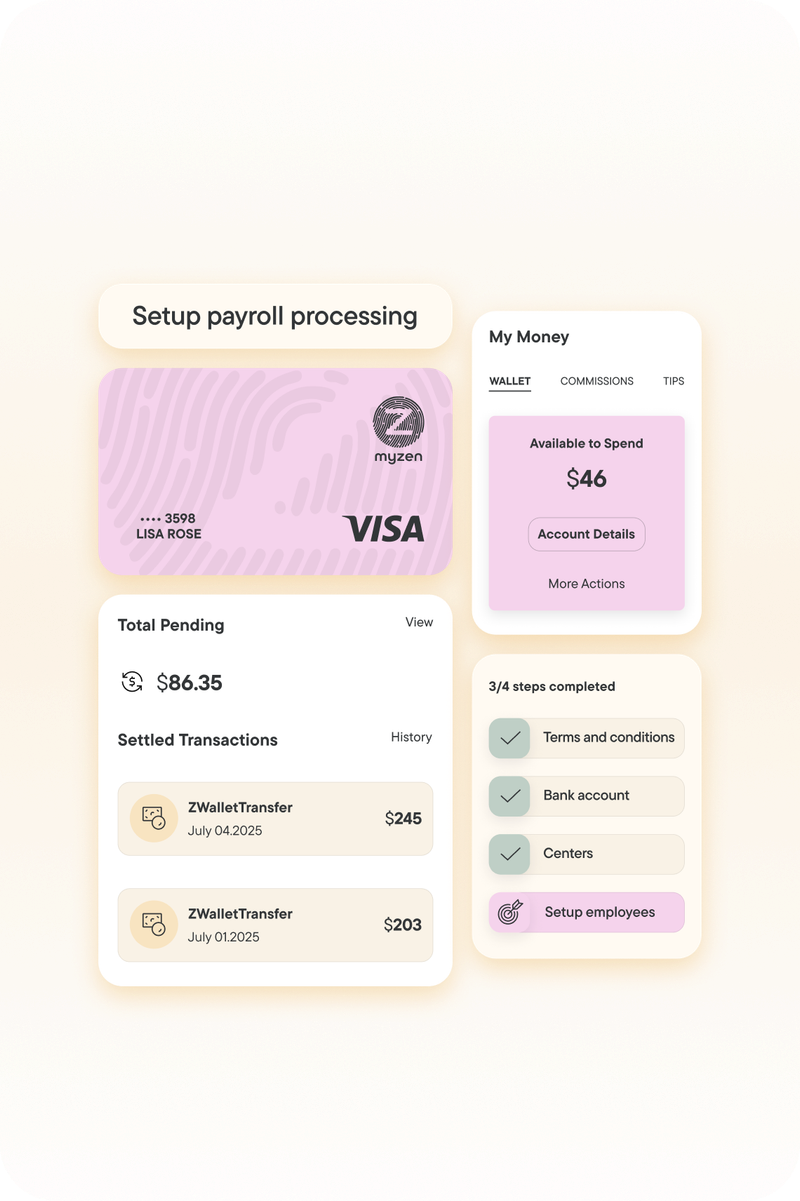
Providers see earnings, pay stubs, and tax documents in the myZen app. Managers get a complete commission breakdown by provider, item type, and location.
Connected to payroll
Commissions, tips, and bonuses flow directly into Zenoti Integrated Payroll — with next-day direct deposit and unlimited payroll runs — so payday takes a click, not a full day.
How Zenoti commission management works
Choose the structure for each item type — services, add-ons, products, memberships, packages, gift cards. Set flat values, percentages, or tiered rates, and decide whether commissions calculate on the original price or the sale price after discounts.
As invoices close, Zenoti applies your rules to every transaction — handling provider splits, cost deductions, tenure bonuses, request-therapist bonuses, and redo penalties without manual intervention.
Run the Employee Commissions report at centre or organisation level, export to Excel or CSV, and process payouts through Zenoti Integrated Payroll in a single click.

Track commissions by service, product, membership, and package
Every revenue stream in your business can carry its own commission logic. Configure separate rates for services, add-ons, retail products, memberships, packages, gift cards — even free services redeemed through loyalty programmes or discounted invoices.
Three levels of configuration: Item level sets organisation-wide defaults. Employee level creates exceptions for individual providers — for example, a senior stylist earning a higher rate. Job level applies rules by role so every stylist at the same level inherits the same plan. Item-level configuration takes precedence, keeping exceptions predictable as your team grows.
Tiered commission rates that update automatically
A tiered commission structure pays providers an increasing rate as their revenue grows — for example, 10% commission on revenue up to a threshold, with a higher rate above it. The goal is to reward high performance without renegotiating individual pay deals as providers grow.
In Zenoti, you define the revenue ranges and the rate for each tier. Providers move up automatically as their sales grow, and Zenoti applies the correct rate at every payroll run — with no manual recalculation.
Tier versioning: Update rates from an effective date while past pay periods keep the values that were in force at the time. An October payroll and a November payroll can use different rates with no manual correction. Choose highest-qualified or cumulative calculation, whichever matches your compensation philosophy.
Calculate salon commissions without spreadsheets — including the hard cases
What Zenoti handles automatically — the scenarios that break spreadsheets:
Split services
When two providers share a guest — an assistant prepping and a senior stylist finishing, or a medspa provider supported by an aesthetician — the front desk sets the split at payment (say, 70/30) and each provider's share calculates through their own commission plan.
Discounted services
Configure whether commission calculates on the original service price — protecting provider earnings when guests redeem discounts or loyalty rewards — or on the sale price after discount. The setting is configurable per item type.
Cost deductions
Deduct costs at the invoice level or against total commission, including shop cost, labour cost, guest cost, and cost to centre — so a commission on a colour service doesn't pay out a percentage of your product cost.
No-shows and cancellations
Optionally award commission when a booked guest doesn't show — as a flat amount, a percentage of the cancellation or no-show fee collected, or based on the original service price — so providers aren't penalised for time they reserved.
Hybrid pay models
Hourly rates are configured per work task and calculated independently. The Employee Hourly Pay/Service Commission report puts hourly earnings and service commission side by side for providers on guaranteed-base models.
A split commission divides a single service invoice between two or more providers, each earning their configured rate on their portion of the service revenue.
Commission levers that motivate the behaviours that grow your business
What these levers do: commission plans are incentive plans. Each of the following goes beyond a flat rate to reward specific behaviours — retail attachment, guest loyalty, seniority, and recurring revenue — that distinguish high-performing salons and spas.
 Retail attachment. Calculate product commissions on total product revenue, product sales per guest, or the ratio of product sales to service sales. The ratio model rewards providers who consistently attach retail items — not just those with the highest volume.
- Loyalty and seniority. Tenure commissions reward providers based on years with your business, helping retain the senior stylists and spa therapists whom guests ask for by name.
- Guest demand. The Request Therapist Bonus pays providers a flat value or percentage when a guest specifically requests them — turning personal client books into recognised, rewarded value.
- Recurring revenue. Award sales commission each time a guest makes a recurring payment on a series package, so the provider who sold it keeps earning as the revenue arrives.


Commission payouts that flow straight into payroll
Commission software that ends with a report still leaves you re-keying numbers into your payroll tool. Because Zenoti Integrated Payroll is built into the same platform, hourly pay, salary, every commission type, tips, and bonuses calculate automatically from the transactions already recorded.
What's included with Zenoti Integrated Payroll: Unlimited payroll runs — including off-cycle runs for one-time bonuses or commissions. Next-day direct deposit. Automated tax filing across all 50 U.S. states. W-2 employees and 1099 contractors. Same-day tip payouts to the Zenoti Wallet. Currently available in the United States.
Commission reporting across every location
The Employee Commissions report gives managers a complete breakdown of revenues and commissions each provider earns — by services, products, memberships, packages, free services, and gift cards — plus tenure bonuses, request-therapist bonuses, redo penalties, deductions, and tips.
Multi-location reporting: View in tabular or graphical format, export to Excel or CSV, and run at centre level or across your entire organisation with per-centre attribution. Multi-centre payroll runs for every location sharing a pay period in a single click — the difference between a payroll week and a payroll afternoon for multi-location brands.


Pay transparency your team can trust
Commission disputes usually stem not from outright dishonesty, but from a lack of transparency. Zenoti gives providers and managers the same numbers: providers track earnings, view pay stubs, and download tax documents in the free myZen app, while managers see the identical breakdown in commission and payroll reports.
When everyone can see how the maths was done, pay conversations get shorter — and your best people stay.
2026 Benchmark data: Staff utilisation at top-performing salons and spas reaches 76–79% versus a 47–49% median. Compensation plans that reward productivity are how operators close that gap. Source: Zenoti 2026 Beauty and Wellness Benchmark Report.
Trusted by 30,000+ salon, spa, and medspa businesses across 50+ countries




























































































FAQs
Most salons, spas, and medspas pay providers through a mix of hourly wages, service commission, and retail commission — and calculating those payouts by hand is one of the most error-prone tasks in the business. Commission management software applies your rules automatically: when an invoice closes, the system calculates each provider's share, accounts for splits, deductions, and bonuses, and rolls everything into a payroll-ready total. In Zenoti, commission rules are configurable at three levels — item, employee, and job — so you can set organisation-wide defaults and still make exceptions for individual services or senior staff.
Owners rarely run one commission rate across the whole team, and Zenoti is built for that reality. Set a flat dollar amount per service, a percentage of revenue, or revenue tiers where the rate increases as a provider's sales grow. Each item type carries its own configuration. Define rules once at the item level for the whole organisation, then create exceptions at the employee level or apply rules by job so every employee with the same role inherits the same plan.
Tiered structures reward providers for growing their sales, but they're painful to administer manually. In Zenoti, you define revenue ranges and the commission rate for each; the system tracks each employee's revenue and applies the correct rate automatically at payroll. Versioning matters more than most owners expect: if you raise a tier's rate mid-quarter, Zenoti applies the new value from its effective date while past pay periods keep their original rates.
Whether to pay commission on the menu price or the discounted price is one of the most debated compensation questions in the industry. Zenoti removes the ambiguity: the sale-price-after-discount option calculates commission on what the guest actually paid, while the revenue option calculates it on the original price regardless of discounts or loyalty redemptions. Because the choice is configurable per item type rather than fixed, you can set the policy that matches your culture and margins.
Team-based service delivery breaks most manual commission systems, because one invoice has to produce two correct payouts. Zenoti handles splits natively: when employees share a service, specify how the commission divides directly from the Appointment Book or POS at payment time. Each provider's portion flows through their own commission configuration and appears on their own payroll, with no spreadsheet reconciliation.
A flat commission on a colour service quietly pays the provider a percentage of your product cost. Zenoti supports two deduction styles: on each invoice (deducted from the service amount before the rate applies) or on total commission (deducted from the provider's commission total for the period). For cancellation and no-show fee invoices, choose which cost components to deduct from revenue. Deductions appear transparently in the Employee Commissions report.
Retail commission is usually a flat percentage, which rewards busy providers but does nothing to change behaviour. Zenoti's three calculation models provide sharper levers. Product revenue is the classic model. Product sales per guest rewards consistency by measuring retail revenue against guests served. Product-to-service sales ratio pays based on how much retail a provider sells relative to their service revenue — the model that turns your commission plan into a retail attachment incentive.
When a guest no-shows, the provider loses the time and the earnings — even if the business collects a fee. Zenoti lets you share that fee revenue with the affected provider. Choose the commission type at centre level: based on the original service price or fee collected, a flat value per cancelled or no-show invoice, or a percentage of the cancellation or no-show fee. Once the front desk marks the appointment and closes the invoice, commission calculates automatically and appears in the Employee Sales No-Show/Cancelled report and the provider's paycheck.
Many salons run a "greater of" or hybrid model — providers earn an hourly base, and commission kicks in when their sales justify more. In Zenoti, hourly rates are configured per work task on the employee profile, service commissions accrue from closed invoices, and the Employee Hourly Pay/Service Commission report puts both side by side so payroll reflects the correct outcome. Combined with overtime configuration and the Employee Payroll Summary report, this supports compliant hybrid compensation without spreadsheet gymnastics.
Because Zenoti Integrated Payroll is built into the same platform, earnings flow straight from closed invoices to paychecks: hourly pay, salary, all commission types, tips, and bonuses are calculated automatically from transactions recorded in Zenoti. Run payroll as often as needed — including off-cycle runs for one-time bonuses or commissions — with next-day direct deposit, automated federal and state tax filing in all 50 U.S. states, and W-2 and 1099 support. Employees track earnings, view pay stubs, and download tax documents in the myZen app. Zenoti Integrated Payroll is currently available in the United States.