
 AI Workforce


How to Write a Spa Business Plan: The Complete Step-by-Step Guide
Whether you're opening a boutique day spa or a full resort wellness center, a solid business plan is the foundation of your success. This guide covers every section you need — plus a free downloadable spa business plan template.
Spa business planning doesn’t have to be daunting. This step-by-step guide walks you through every part of building a spa business plan — market, services, staffing, technology, and financials — with a free template you can fill in as you go.

Trusted by the fastest-growing salons in the world





































What to Include in a Spa Business Plan
A spa business plan covers nine core sections. Together they tell the full story of your business — what it is, who it serves, how it operates, and whether it will be profitable.
Executive Summary: a concise overview of the entire plan (written last, placed first)
Business Description and Concept: what kind of spa you're opening and what makes it distinctive
Market Analysis: industry data, local competitor landscape, and target client profile
Service Menu and Pricing Strategy: what you'll offer and how you'll price it profitably
Operations Plan: location, design, treatment rooms, and equipment
Staffing Plan: structure, qualifications, hiring model, and commission approach
Technology and Software Requirements: the systems that will run your spa
Marketing Strategy: how you'll attract and retain clients before and after opening
Financial Projections: startup costs, revenue model, and path to profitability
If you're planning a medical spa rather than a day spa or wellness center, see our dedicated medical spa business plan guide, which covers the additional requirements of a clinical operation.
Key Sections of Your Spa Business Plan
Spa Market Analysis
Map every spa within your target service area. For each competitor, record: location, price range, service categories, estimated capacity (number of treatment rooms), and any obvious gaps in their offering. Reference current data from the International Spa Association (ISPA) or the Global Wellness Institute. Present local competitor data as a table — Name | Location | Price Range | Service Categories | Strengths | Gaps.
Service Menu and Pricing Strategy
Massages, facials, and body treatments are the core of most spa menus. Use a combination of cost-plus pricing (full cost plus target margin), competitive pricing (relative to local benchmarks), value-based pricing (premium for brand and experience), and package pricing (bundled treatments at 10–15% discount). Avoid underpricing at launch — clients get accustomed to your prices, so raising them later is significantly harder than launching at the right level.
Operations Plan — Location and Equipment
Each standard treatment room requires roughly 120–150 square feet for a single treatment table with adequate circulation space. Add 20–30% for reception, retail, changing facilities, and back-of-house. Spa outfitting typically costs $100–$300 per square foot. A 2,000 sq ft day spa with three treatment rooms and no wet areas might cost $200,000–$400,000 to build out. Include a contingency of at least 15%.
Staffing Plan
Most day spas require: a spa director or manager, licensed massage therapists and/or estheticians, front desk reception staff, and at some scale a retail or membership sales role. Therapist compensation is typically a combination of base pay and commission on services performed (30–50% of service revenue is common), plus tips. Build your staffing plan to your projected year one and year two occupancy, not to theoretical capacity.
Technology and Software Requirements for a Spa
Technology is one of the most frequently underplanned sections of a spa business plan — and one of the most consequential for day-to-day operations. Investors and lenders want to see that you've identified the systems your business will run on and that their costs are reflected in your projections.
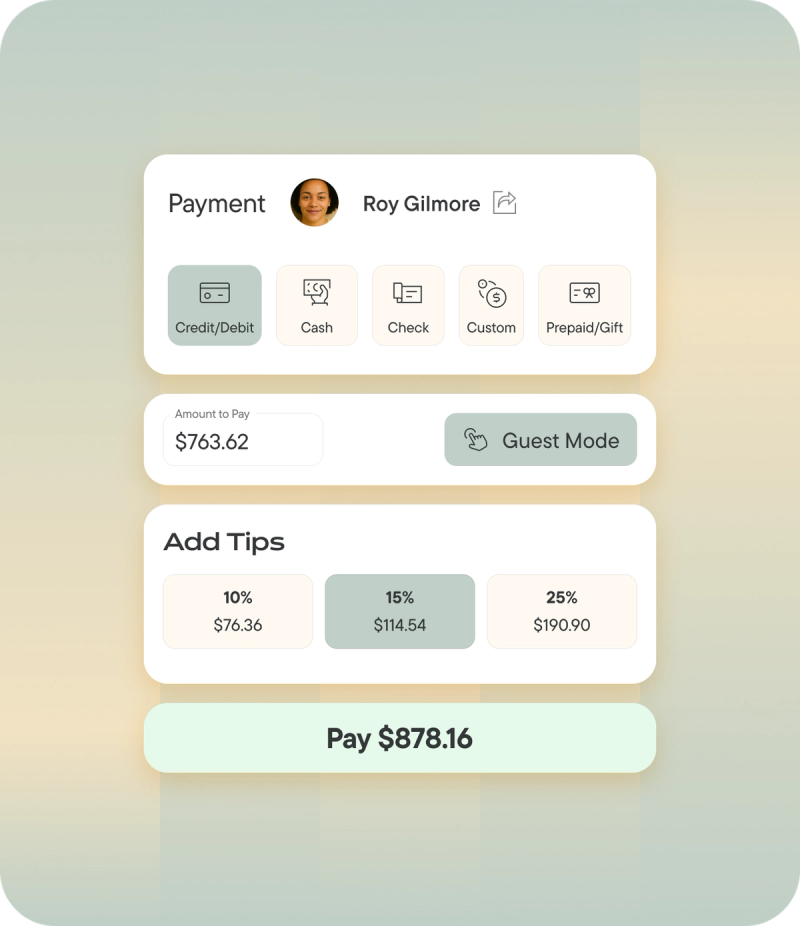
Spa management software. The core operational platform — handles appointment booking, point of sale, client management (CRM), staff scheduling, inventory, and reporting. Effective package and membership management is at the heart of building lasting client loyalty. The decision between integrated all-in-one software and a collection of separate tools has significant implications for monthly cost, administrative overhead, and data quality.
For spa online booking,
spa management software that handles both is significantly more efficient than a booking tool bolted onto a separate POS. An all-in-one platform typically costs less than the sum of the separate tools it replaces.
POS hardware. At minimum: a tablet (iPad or Android), a compatible card reader, and optionally a receipt printer and cash drawer.
Marketing tools. Email and SMS for pre-launch list building and ongoing retention campaigns. If your spa management software includes built-in marketing automation (as Zenoti's does), this isn't a separate cost.
For the platform that runs the day-to-day, see Zenoti’s spa management software.

Spa Marketing Strategy and Financial Projections
A spa that opens without a marketing plan typically opens without clients. Your marketing strategy covers both the pre-launch period — building awareness and your initial client base before you open — and the ongoing marketing that sustains occupancy after launch.
Pre-launch marketing. Build your Instagram presence before the doors open. Collect email subscribers with launch preview content and a founding member offer. Claim and optimise your Google Business Profile before opening day. Send a press release to local media, neighborhood business associations, and hotel concierge networks.
For spa marketing automation that runs without manual scheduling, connect your campaigns to your CRM data so reminders and offers trigger automatically based on client behaviour.
Spa membership management drives retention by creating a financial and habitual connection between your clients and your spa that one-off bookings alone don't generate.
Financial projections. Build a detailed startup cost budget covering: property lease deposit, outfitting and construction, equipment and furniture, initial product inventory, software setup, staff hiring and training, pre-launch marketing, legal and accounting fees, and operating reserve (aim for three to six months of projected monthly operating expenses held in cash at opening).
Realistic startup cost range. A modest three-room day spa in a mid-market location typically requires $75,000–$150,000 in startup capital. A premium six-room spa with a relaxation lounge and retail area in a desirable location can exceed $250,000 before opening. Treatment room utilisation rate is the key driver — spas generally need 65–70%+ utilisation to reach profitability.
Frequently Asked Questions
Write your spa business plan in nine sections: executive summary, business description, market analysis, service menu and pricing, operations plan, staffing plan, technology requirements, marketing strategy, and financial projections. Start with the market analysis and financial sections ��� these form the foundation. Write the executive summary last, after completing all other sections. Use a pre-formatted spa business plan template to guide you through each section.
Spa startup costs typically range from $75,000 to $250,000+ depending on size, location, and outfitting quality. Major cost categories include property lease deposit and outfitting ($40,000–$150,000+), equipment ($10,000–$30,000), initial product inventory ($5,000–$15,000), software and technology ($2,000–$5,000 first year), and operating reserve of three to six months of projected expenses.
A well-run day spa typically achieves a net profit margin of 15–25%. Treatment room utilisation rate is the key driver — spas generally need 65–70%+ utilisation to reach profitability. Membership revenue meaningfully improves margins by providing predictable monthly income. Retail sales at 15–20% of service revenue are an additional margin contributor in well-run operations.
Investors will expect to see a business plan if you are seeking a business loan or investor funding, and lenders will require one. Even if you are self-funding, a business plan is valuable because it forces you to work through the financials, identify potential challenges, and create an operational roadmap for launch. The planning process itself is as valuable as the document.
Spa business planning means working through five things before you open or expand: your market and ideal client, your service menu and pricing, staffing and payroll model, the technology and software you’ll run on, and financial projections (start-up costs, break-even, and cash flow). Capturing all five in a written spa business plan is what turns an idea into a fundable, runnable business — use the free template above to start.